ADIPEC 2026|Paper: The Invisible Domino in the Maritime & Port Ecosystems · 5 November 2026

Partnership · PTR-02 · Strategic

Resilience doctrine needs infrastructure that can carry it.

ASR maps where systems break and what they cannot substitute. The Autonomy Institute builds the open, standardised infrastructure layer those systems increasingly run on. The partnership joins a method for measuring fragility to a substrate capable of doing something about it.

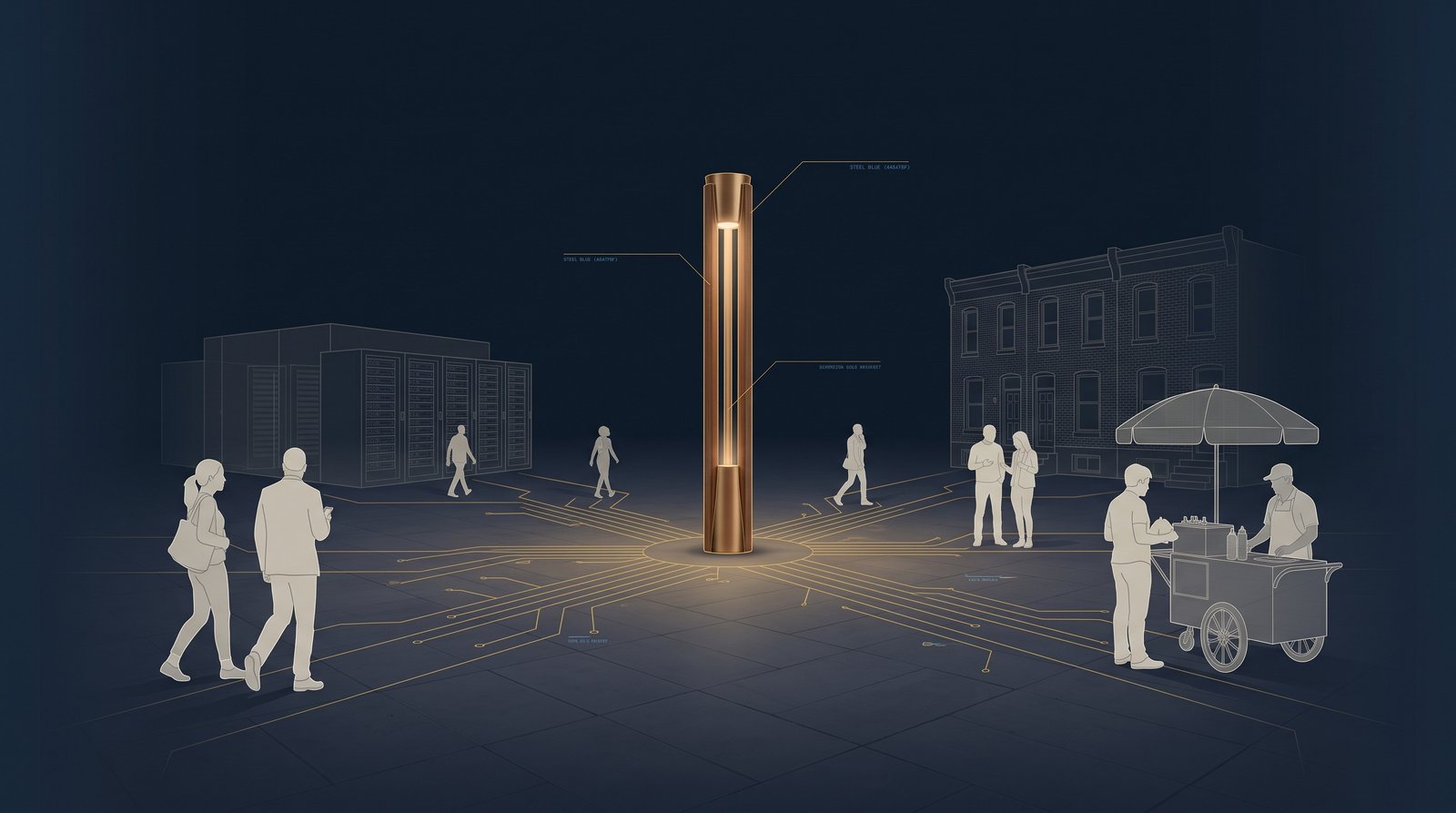
A Public Infrastructure Network Node standing in a city sidewalk, its fiber, power and edge-compute connections fanning out beneath the pavement to surrounding buildings, a data centre and the people passing by.
PINN · Public Infrastructure Network NodeOne standardised node in the right-of-way, carrying the fiber backbone, wireless, power and edge computing that a corridor’s digital layer otherwise acquires piecemeal. In ASR terms: the point where a mapped dependency becomes a monitored one.
Institute partners
400+
Collaborators
3,000+
Projected upgrade-cost reduction
70%
ASR domains mapped
6 of 6

Partner, collaborator and cost-reduction figures are the Autonomy Institute’s own, as published at autonomy.institute.

01 · The partner

Who the Autonomy Institute is.

The Autonomy Institute is a 501(c)(3) consortium of industry, government and academic organisations working to accelerate the deployment of Intelligent Infrastructure — the physical and digital layer that autonomous systems, edge computing and the AI economy actually run on.

Its position is that the great economic transitions are infrastructure transitions, and that the current one is being deployed as a patchwork of vendor-specific equipment attached to whatever pole was available. The Institute’s answer is a set of open standards, a neutral-host physical node, a governance model for the data those nodes create, and a financing structure capable of paying for all three.

For ASR, this matters for a specific reason. Across the case work — Karachi, Jebel Ali, Singapore — the pivot domino is increasingly found on the digital layer rather than the physical one. A customs platform gates regional trade more tightly than a berth does. Instrumentation, standards and data sovereignty are therefore not adjacent concerns to resilience. They are where the binding constraint now sits.

Programme set

Six programmes, one stack.

The Institute’s work is not a single product. It is a layered set of standards, physical nodes, operating centres and financing instruments — each of which touches a different layer of the ASR node registry.

I3

Intelligent Infrastructure

The Institute's core thesis: a unified, open, publicly governed digital backbone rather than disparate private systems bolted onto city poles. It treats connectivity, compute and sensing as public infrastructure with standards, not as vendor deployments.

PINN

Public Infrastructure Network Nodes

A neutral-host node installed into the sidewalk — the Institute describes it as a “condo for electronics” — carrying fiber backbone, NextG wireless, power, edge computing, radar and lidar, environmental sensing and assured position, navigation and timing in one standardised enclosure.

IIEZ

Intelligent Infrastructure Economic Zones

Regional zones that pair municipal and state authority with private capital to fund deployment, creating a defined asset class rather than relying on discretionary public budgets.

ASOCC

Autonomous Systems Operational Control Centers

The regional operating layer for autonomous and connected systems — the place where situational awareness is consolidated and where degraded-mode decisions are actually taken.

ADT

Active Digital Twins

Real-time virtual replicas of corridors, ports and districts, used for simulation, planning and orchestrating emergency response — a live model rather than a static as-built record.

SDX

Sovereign Data Exchanges

Data governance in which privacy, security and ownership remain with the residents, cities and operators generating the data — a structural answer to the dependency ASR rates on the digital layer.

02 · The premise

Mapping fragility and removing it are two different disciplines.

What ASR brings

A method. Six interdependent domains, three node classes, and a scoring discipline that produces the System Resilience Value — a forecast of uptime and mitigation capacity over a ten-year horizon rather than a compliance score. ASR is explicit that instability is the operating condition, not the exception, and that the useful question is what a system can still do while degraded.

What the Institute brings

A substrate and the standards that govern it. Open specifications, a neutral-host node deployed in public right-of-way, regional operating centres, live digital twins, and a financing model that lets a city or corridor fund the work. Where ASR names a dependency, this is the layer on which the dependency can be instrumented, hedged or designed out.

Neither half is sufficient alone. Infrastructure deployed without a fragility model instruments whatever is easiest to reach. A fragility model without infrastructure produces an accurate description of a problem nobody has the means to act on. The partnership exists to close that gap in both directions.

03 · Alignment

Where the two frameworks meet, layer by layer.

01 · Physical

Plants, terminals, berths and the hard assets revenue physically depends on.

PINN puts power, fiber and compute into the right-of-way itself, so the sensing layer no longer depends on the asset it is meant to observe.

02 · Digital

The systems that quietly hold veto power over operations — SCADA, customs platforms, decision agents.

Open PINN and I3 standards replace single-vendor dependency with a specified, substitutable stack; Sovereign Data Exchanges keep authority over the data with the operator.

03 · Financial

Working capital, settlement rails and the credit paths that keep suppliers moving.

The IIEZ model funds resilience capacity as infrastructure investment rather than as an operating cost defended each budget cycle.

04 · Geographic

Corridors, chokepoints and the places where every route converges onto one line on the map.

Corridor-scale deployment instruments the chokepoint directly, turning a mapped dependency into a monitored one.

05 · Human

The people, skills and command relationships that carry a system through a degraded week.

ASOCC gives commander's-intent doctrine somewhere to live — a staffed operating floor rather than a document.

06 · Institutional

Operator and regulator structure, statutory lines and continuity of authority.

Standards work converts resilience from an operator preference into a published requirement that regulators and procurement can reference.

04 · Workstreams

What the partnership is actually doing.

WorkstreamWS-01

Resilience criteria inside the standards

Contributing ASR's fragility and dependency criteria to Intelligent Infrastructure standards work, so that continuity under degraded conditions is specified at design time rather than assessed after commissioning.

WorkstreamWS-02

Node registry alignment

Mapping the ASR six-layer node registry onto I3 and PINN asset definitions, so a deployed corridor produces the exposure, dependency and replaceability inputs the framework needs — without a separate survey.

WorkstreamWS-03

Degraded-conditions protocols

Testing ASR's 72-hour autonomous operating window against ASOCC operations and Active Digital Twin simulation — establishing what a node can decide on its own when the network above it is unavailable.

WorkstreamWS-04

Joint research and briefings

Shared publication on operating through sustained instability, drawing on ASR case work in ports and industrial corridors and on the Institute's deployment experience.

05 · Consequence

What changes for an operator.

An operator running a port, a corridor or an industrial estate is usually holding two unconnected documents: a resilience assessment, and an infrastructure roadmap written by a different team on a different timetable. The first identifies what would hurt. The second specifies what will be built. They rarely reference each other.

The intent of this partnership is that they should. A node registry that speaks the same vocabulary as the deployment standard makes it possible to ask whether a planned corridor build actually reduces the fragility that was measured — and to answer in the same units the assessment used.

The 72-hour window is the sharpest version of the test. If regional coordination is unavailable for three days, what can a node still decide, sense and power on its own authority? That question is doctrine on the ASR side and hardware, standards and operating procedure on the Institute’s. It is only answerable jointly.

The test

Three days without the network above you.

Degraded-conditions protocols are structured around a 72-hour operational window. Intelligent Infrastructure is where that window becomes a specification rather than an aspiration.

72hAutonomous operating budget
Discuss a corridor or port assessmentThe ASR frameworkAll partnersautonomy.institute ↗